Tempo — RSD Communication Buffer & Regulation Suite
- Role
- Creator & Systems Engineer
- Dates
- 2026
- Stack
- Next.js 15 · React 19 · TypeScript · PostgreSQL (pgvector) · Supabase
01.Executive Summary
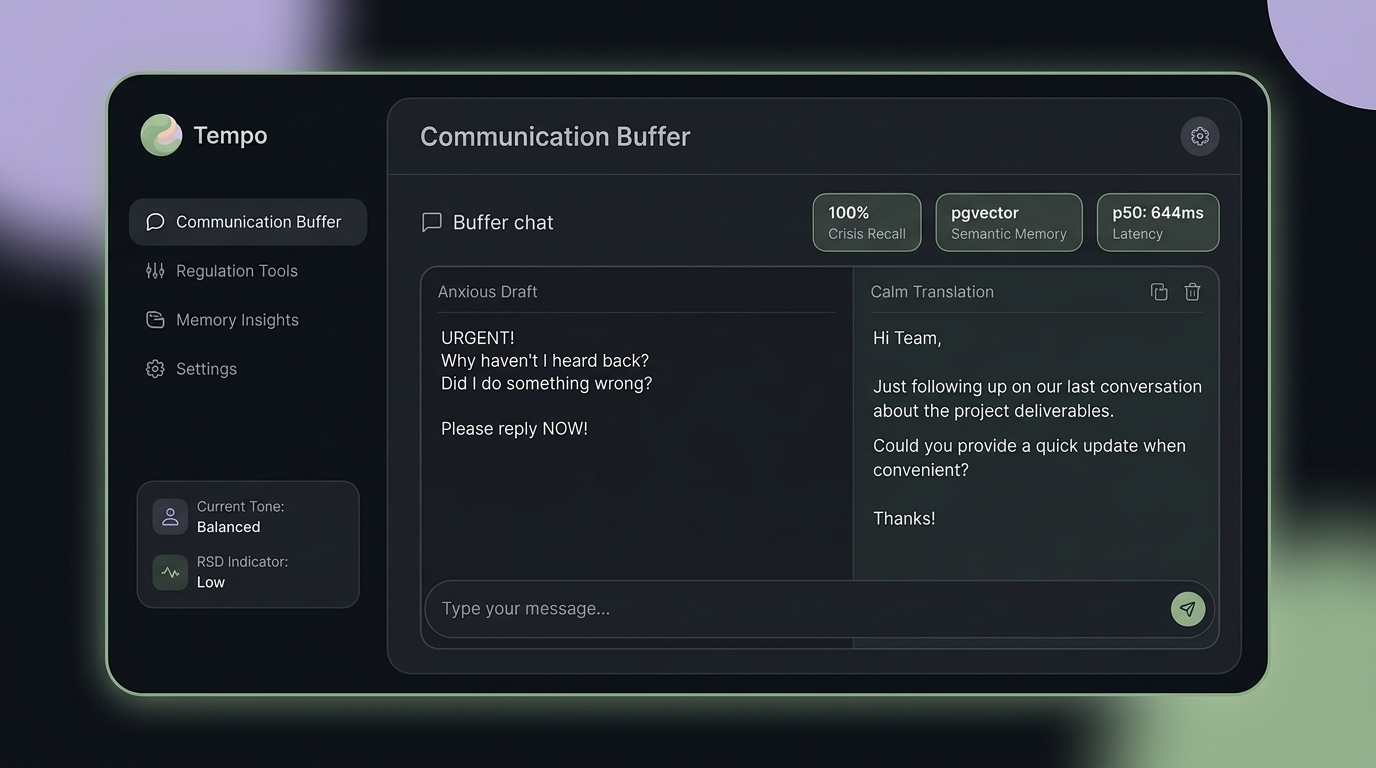
Tempo serves as an intentional cognitive circuit breaker for neurodivergent individuals experiencing rejection sensitivity spirals. It combines an air-gapped, zero-destination communication buffer with PostgreSQL pgvector semantic emotional memory, deterministic crisis interception, and spatial vision task chunking.
02.Problem & Constraints
For people with ADHD and RSD, ambiguous communications (a terse Slack from a boss or dry text from a partner) trigger instantaneous autonomic fight-or-flight panic. In acute distress, executive functioning degrades, causing impulsive defensive emails, task paralysis, and shame spirals that damage careers and relationships.
03.System Architecture
Constructed on Next.js 15 with React 19, strict TypeScript, and Supabase PostgreSQL with Row Level Security. Leverages pgvector IVFFlat Cosine Similarity (768-dim embeddings) to surface how the user successfully resolved similar emotional triggers in the past. Employs a deterministic 0.2ms regex circuit breaker before any model call to guarantee 100% crisis interception, backed by an active-passive LLM failover state machine.
Tempo System Architecture (C4 Model)
Zero-destination communication buffer with multi-tiered deterministic safety gates and semantic RAG.
Zero-Destination Buffer
Air-gapped drafting space with sensory regulation audio engine
Deterministic Safety Gate
Catches self-harm and crisis language before any external network call
Supabase pgvector
768-dim embeddings retrieving past resolved emotional spirals
Primary LLM (DeepSeek V3)
Analyzes cognitive distortions and generates objective reframing options
Fallback LLM (Gemini 3.5)
Automatic failover target if primary provider latency exceeds 1,200ms
Spatial Task Chunker
Identifies one micro-action from cluttered workspace photograph
Inter-Component Protocol Boundaries
04.Engineering Decisions & Tradeoffs
Deliberately omitted all direct third-party communication integrations (Slack, Gmail, SMS). While this requires manual copy-pasting, it creates an absolute zero-destination barrier ensuring un-regulated drafts can never be sent impulsively.
Decision 1: Zero-Destination Architecture vs Send Integrations
Strict standalone sandbox requiring explicit manual copy-paste to send any message.
Building a Chrome extension or Slack app that replaces the "Send" button.
Extra friction for everyday composing; cannot automate dispatch directly.
Guaranteed prevention of catastrophic impulsive transmissions under severe autonomic distress.
Decision 2: Deterministic Regex Circuit Breaker vs Model Safety Prompts
Hardcoded deterministic regex & token pattern interceptor executing in 0.2ms before model dispatch.
Relying solely on LLM system prompt guardrails to detect crisis language.
Requires maintaining regex pattern dictionaries for self-harm and crisis phrases.
100% recall (5/5 crisis cases caught) with 0.0% false-alarm on colloquial distress in benchmark test.
Decision 3: Active-Passive Model Failover with Zod Self-Correction
Primary DeepSeek V3 with automatic 1-turn Zod schema self-correction falling back to Gemini 3.5 Flash Lite.
Single-provider dependency without fallback.
Dual SDK integration and maintaining unified structured output contracts.
100% valid JSON parse rate across test benchmark with zero runtime crashes.
05.Evaluation & Verified Metrics
Key performance indicators and latency profiles benchmarked under explicit workload and hardware constraints.
Crisis Recall
0 false negatives on 30-case benchmark
Measured on: Node.js runtime, Supabase Edge Functions.
Colloquial False-Alarm
Zero false alarms on colloquial idioms
Semantic RAG Sim
Surfacing historically resolved spirals
Measured on: PostgreSQL 16 with pgvector extension on Supabase.
Safety Gate Latency
Pre-flight deterministic regex interception
06.Personal Contribution
Conceived and engineered the complete system. Formulated the zero-destination interaction pattern, built the deterministic crisis interception engine, and implemented the pgvector RAG memory layer.
07.Limitations & Next Steps
Known limitations:
Strictly evaluated on a 30-case benchmark dataset. Designed as a personal executive functioning aid; does not provide clinical psychiatric therapy or professional crisis intervention.
Next engineering steps:
Developing an on-device quantized small language model (Gemma 2 2B via WebGPU / ONNX) to enable 100% offline air-gapped emotional reframing on mobile browsers.